

Tea Culture and Ceremonies
Fermented tea or oxidized tea? The scientific difference explained
Aug
Fermented tea or oxidized tea? Few terms cause as much confusion in the world of tea. Black tea is often called “fermented tea” – yet from a scientific standpoint that is usually not correct at all. In this article, we explain the real difference between fermentation and oxidation, why black tea turns dark, and how both shape flavor and aroma.
1. The World of Tea: One Plant, Many Flavors
Whether green tea, white tea, Oolong or black tea: all “true” teas come from a single plant – Camellia sinensis. What makes the varieties so different is not the plant, but the processing of the harvested leaves. This is exactly where the two key terms come into play: oxidation and fermentation. In our black tea range you’ll find the full spectrum of robust varieties – but before we get to the recommendations, let’s clear up the terminology.
2. What Does Fermentation Mean in Tea?
In everyday language, “fermentation” is often used as a synonym for “oxidation.” Scientifically, however, these are two different processes.
2.1 True Fermentation by Microorganisms
True fermentation means that microorganisms such as bacteria and fungi transform the leaves – much like with sauerkraut, cheese or wine. This microbial activity breaks down and rebuilds compounds, creating entirely new aromas. For most types of tea, this process does not take place.
2.2 Pu-Erh Tea as the Best-Known Example
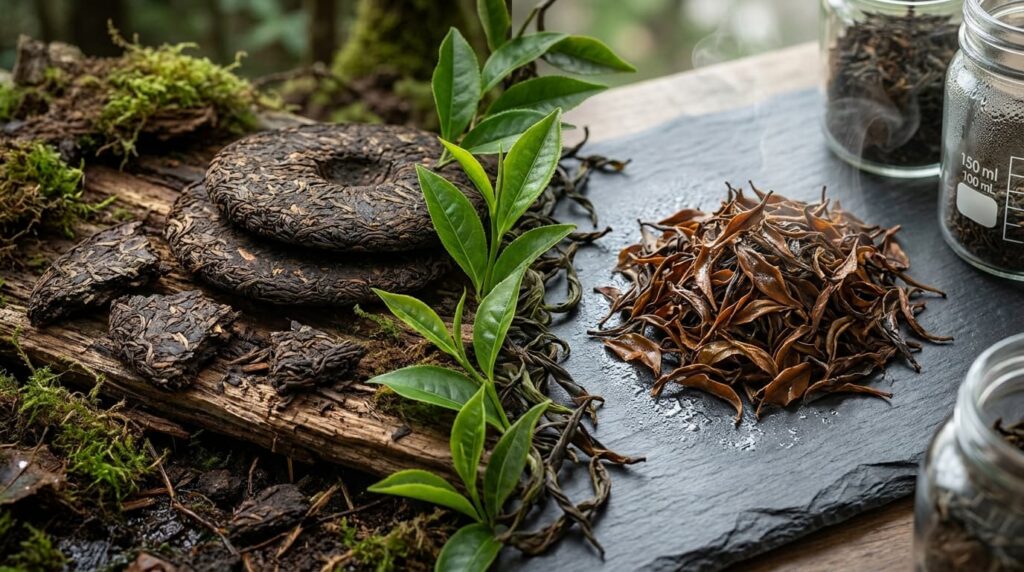
The only widely available tea that is genuinely fermented is Pu-Erh from the Chinese province of Yunnan. Here the leaves mature under controlled humidity over weeks, months or even years, while microorganisms make the flavor deep, earthy and mellow. Anyone who would like to sample this special character will find an authentic organic China Pu-Erh from Yunnan in our shop.
2.3 How Does Fermentation Change the Flavor?
Fermentation typically makes tea milder, rounder and earthier. The initial astringency gives way to a soft, woody-sweet profile. This is precisely what fundamentally sets a matured Pu-Erh apart from a classic black tea.
3. What Does Oxidation Mean in Tea?
What many people call “fermentation” is in truth oxidation – and it happens entirely without microorganisms.
3.1 The Role of Oxygen and Enzymes
As soon as the cell walls of the tea leaves are damaged by rolling or breaking, the plant’s own enzymes (above all polyphenol oxidase) come into contact with oxygen. It’s the same effect you see when a sliced apple turns brown. This enzymatic process is the heart of black tea production.
3.2 Why Does the Color of the Tea Leaves Change?
Through oxidation, the green catechins are converted into dark color pigments. The leaves turn from green to coppery red to deep brown – and it is precisely this color change that signals how far oxidation has progressed.
3.3 Theaflavins and Thearubigins: The Emergence of Typical Black Tea Aromas
During oxidation, two important compounds are formed: theaflavins provide brightness, freshness and a slightly astringent character, while thearubigins deliver depth, body and the typical malty, dark note. Their ratio largely determines how a black tea tastes.
4. Is Black Tea Fermented or Oxidized?
The clear answer: black tea is fully oxidized, not fermented. The term “fermented tea” has become established historically, but it is misleading. Only Pu-Erh undergoes true microbial fermentation. All other dark teas – from Assam to Ceylon – owe their color and strength to oxidation.
5. How Black Tea Is Made, Step by Step
How does a green leaf become a robust black tea? In five steps:
5.1 Harvesting the Tea Leaves
Usually the tender bud and the two uppermost leaves are picked. The finer the plucking, the higher the quality of the tea.
5.2 Withering
Over the course of several hours, the fresh leaves lose part of their moisture and become soft and supple – the prerequisite for rolling them without breaking.
5.3 Rolling
During rolling, the cell walls are broken open. This releases enzymes and cell juices – the starting signal for oxidation.
5.4 Oxidation
In a controlled, humid environment, the leaves now react with oxygen. Depending on the desired profile, this step takes between 30 minutes and several hours – it determines color, strength and aroma.
5.5 Drying
Finally, the leaves are heated. The heat stops oxidation abruptly and preserves the aroma that has developed. What remains is the finished, storable black tea.
6. Fermented Tea vs. Oxidized Tea: A Direct Comparison
| Characteristic | Fermented Tea (Pu-Erh) | Oxidized Tea (Black Tea) |
|---|---|---|
| Trigger | Microorganisms (bacteria, fungi) | Enzymes + oxygen |
| Duration | Weeks to years | Minutes to hours |
| Flavor | earthy, mellow, woody | robust, malty, astringent |
| Color of the infusion | deep brown to reddish | amber to dark red |
| Maturation | can improve over the years | best enjoyed fresh |
7. How Does Oxidation Influence Flavor and Aroma?
The degree and conditions of oxidation – combined with origin and climate – explain why no two black teas taste the same:
Assam Black Tea
Robust, malty and full-bodied – ideal for the morning and as a base for tea with milk. Try our organic Bio Assam FTGFOP-1.
Darjeeling Black Tea
Finer, more floral and lighter, often with a Muscatel note – the “champagne among teas.” Discover the organic Bio Darjeeling SFTGFOP-1.
Ceylon Black Tea
Balanced, fresh and lively with a citrusy note, from Sri Lanka: our organic Bio Ceylon OP Ahinsa.
China Black Tea
Mellow, slightly smoky and sweet – like the classic organic Bio China Lapsang Souchong with its unmistakable smoky aroma.
8. The Difference Between Green Tea, Oolong and Black Tea
The degree of oxidation is the key to the types of tea. Green tea is heated immediately after harvesting and is therefore not oxidized – it stays fresh and grassy. Oolong is partially oxidized and sits, in terms of flavor, exactly in between. Black tea is fully oxidized and thus the most robust. A organic Bio China Jade Oolong or a Japan Sencha demonstrate this difference impressively.
9. Why High-Quality Black Teas Taste Different
Besides oxidation, many factors shape the flavor: growing altitude, soil composition, time of harvest (Flush), leaf grade and the care taken during processing. A high-grown second-flush Darjeeling tastes completely different from a robust lowland tea – even though both are fully oxidized.
10. Common Mistakes and Misconceptions About Tea Fermentation
- “Black tea is fermented.” – Wrong: it is oxidized. Only Pu-Erh is truly fermented.
- “Fermentation = longer shelf life.” – Only partly true: classic black tea tastes best fresh, while Pu-Erh can mature.
- “The darker, the more caffeine.” – Color says little about caffeine content.
11. Storage and Maturation: Can Teas Get Better?
Most teas – green, white, Oolong and black – are best enjoyed fresh, stored airtight and protected from light. The big exception is Pu-Erh: it can continue to mature over the years and gain in flavor, much like a good wine.
12. Which Tea Suits Which Taste?
Do you like it robust and malty? Then Assam is your tea. Do you prefer it fine and floral? Reach for Darjeeling. Are you looking for something fresh and balanced? Ceylon is a perfect fit. And anyone who loves the special, earthy should try a Pu-Erh. You’ll find the full spectrum in our organic black tea range.
13. FAQ
Is black tea fermented or oxidized?
Black tea is fully oxidized. The frequently used term “fermented” is not scientifically correct – true fermentation by microorganisms only takes place with Pu-Erh.
What is the difference between oxidation and fermentation?
Oxidation is an enzymatic process involving oxygen (without microbes). Fermentation is triggered by bacteria and fungi and changes the tea over a considerably longer period.
Which tea is truly fermented?
Primarily Pu-Erh from Yunnan. It matures under controlled humidity and develops an earthy, mellow aroma.
Does oxidized tea contain more caffeine?
Not necessarily. Caffeine content depends on the variety, leaf grade and preparation, not on the degree of oxidation alone.
Can black tea get better as it ages?
Classic black tea tastes best fresh. Only fermented Pu-Erh benefits from long maturation.
Conclusion
The difference between fermented and oxidized tea is more than a linguistic subtlety. Black tea is oxidized – an enzymatic process with oxygen that produces color, strength and aromas such as theaflavins and thearubigins. True fermentation by microorganisms only occurs with Pu-Erh. Once you know this difference, you’ll not only understand the labels better, but also find your favorite tea more easily. Browse our organic black tea range and discover which character suits you best.
You might also like
Discover in the shop: all tea varieties view →