

General
Khat (Catha edulis): What Is the Plant Seen So Often in Yemen?
Sep
Khat (Catha edulis): What Is the Plant Seen So Often in Yemen?
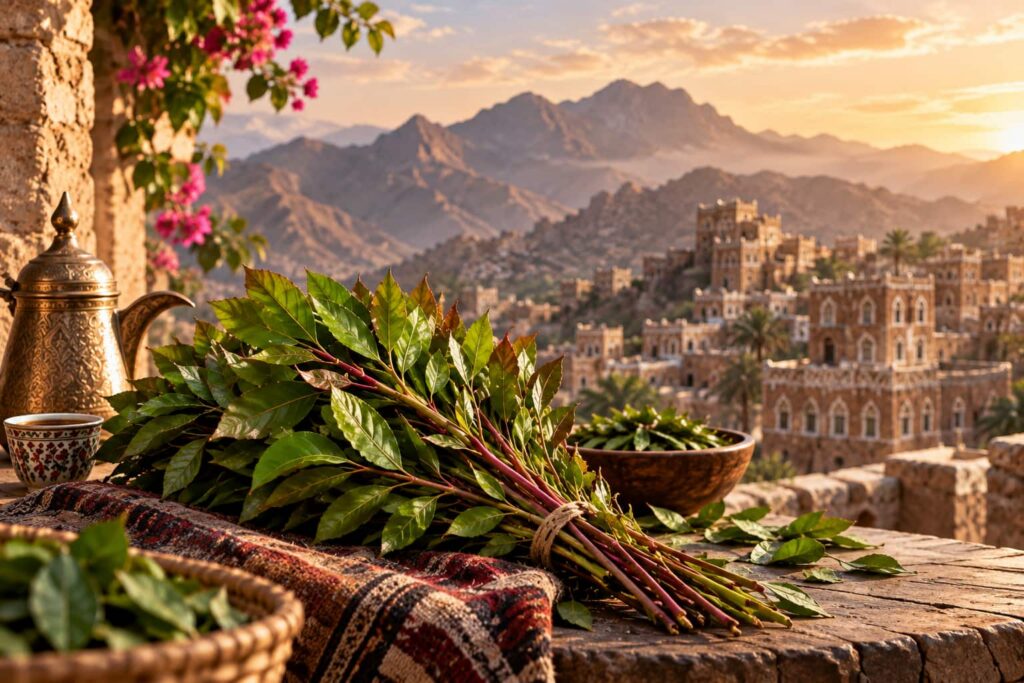
If you have watched videos or seen photographs from Yemen, you may have noticed something unusual: people sitting together for hours, chewing fresh green leaves and often keeping them tucked inside one cheek.
Those leaves are usually khat, also known as qat, kat, kath or chat. The plant’s botanical name is Catha edulis.
Khat has been part of social and cultural life in Yemen and parts of East Africa for centuries. But it is not an ordinary tea plant. Fresh khat leaves contain cathinone, a psychoactive substance with stimulant properties.
For anyone in Germany, there is an important point to understand from the outset: khat cannot legally be bought, sold, imported or possessed like ordinary tea or herbs. Cathinone is controlled under German narcotics law.
In this article, we take a closer look at where khat comes from, why it is so closely associated with Yemen, how it has traditionally been used, what its active compounds do, what science tells us about its effects and risks, and how khat is regulated in Germany and across Europe.
What is khat?
Khat comes from Catha edulis, an evergreen shrub or small tree belonging to the Celastraceae family.
The plant is traditionally cultivated or consumed particularly in parts of:
- Ethiopia
- Kenya
- Somalia
- Djibouti
- Yemen
The young leaves and shoots are the parts most commonly used.
The European Union Drugs Agency (EUDA) describes khat as the leaves and young shoots of Catha edulis. Its principal psychoactive compounds are cathinone and cathine (norpseudoephedrine).
Cathinone is chemically related to amphetamine. Its pharmacological effects are qualitatively similar to those of amphetamine, although cathinone is less potent.
Source: European Union Drugs Agency (EUDA), Khat drug profile.
Where does khat come from?
Although khat is strongly associated with Yemen today, the history of the plant is more complicated.
For many years, historical accounts proposed different regions as its possible place of origin. Modern genetic research has provided some fascinating clues.
A 2017 study published in the American Journal of Botany analysed more than 1,500 wild and cultivated plants from traditional khat-growing regions.
The findings suggest that important centres of origin for cultivated khat are located in Ethiopia and Kenya. Particularly interesting is the genetic evidence indicating that the cultivated Yemeni khat samples examined in the study could be traced back to Ethiopian populations.
So, despite its strong cultural association with Yemen, the idea that khat originated exclusively in Yemen is not supported by current genetic evidence.
Source: Krizevski et al., American Journal of Botany, 2017.
How far back does the tradition of chewing khat go?
Khat has been consumed for centuries.
One of the earliest credible historical references comes from Ethiopia and appears in chronicles dating to the reign of the Ethiopian emperor Amda Seyon I in the early 14th century.
There is also evidence of khat cultivation in Yemen dating back to the 14th century, although clear written references to qat or khat become more common in later sources.
Khat has therefore been cultivated and consumed in Ethiopia and Yemen for at least around 600 years.
European scientific descriptions came much later. The Finnish-Swedish naturalist Peter Forsskål documented the plant in connection with the famous Danish expedition to Arabia in the 18th century. Botanical research into Catha edulis subsequently developed further.
Sources: American Journal of Botany; Archives of Natural History; Journal of Ethnopharmacology.
Why is khat so important in Yemen?
In Yemen, khat is more than simply a plant with psychoactive effects.
Chewing sessions can be social occasions. People meet, talk, discuss everyday matters and sometimes spend several hours together.
Khat therefore has a social and cultural role that cannot be understood purely through pharmacology.
That cultural significance, however, does not mean that khat use is without health consequences.
The World Health Organization (WHO) has discussed a range of health, social and economic problems associated particularly with regular or excessive khat consumption.
How is khat traditionally consumed?
The traditional method is not drinking it as tea, but chewing the fresh leaves and young shoots.
The leaves are chewed over an extended period and are often held in a pouch inside the cheek. Their active compounds are gradually absorbed through saliva and the digestive system.
Why does freshness matter?
The main psychoactive compound, cathinone, is relatively unstable.
After harvesting, cathinone levels decline as the compound breaks down or is chemically transformed. This is one reason fresh leaves are traditionally preferred when the stimulant effect is desired.
Historically, dried leaves have also been used and sometimes prepared as an infusion. This helps explain older names such as Abyssinian Tea and Arabian Tea.
These names can be misleading, however. Pharmacologically, khat is very different from ordinary black tea, green tea or herbal infusions.
What are the active compounds in khat?
Cathinone
Cathinone is considered the main stimulant compound in fresh khat leaves.
Chemically, it is the β-keto analogue of amphetamine. Its effects on the central nervous system share certain characteristics with amphetamine, although cathinone is less potent.
Cathine
Cathine, also known as norpseudoephedrine, also has stimulant properties but is weaker than cathinone.
Khat additionally contains many other plant compounds, including tannins, flavonoids, terpenes, sterols and compounds known as cathedulins.
Sources: EUDA; WHO; Al-Hebshi & Skaug, Addiction Biology.
What does khat do?
Its effects vary depending on factors such as the amount consumed, the freshness of the leaves, individual sensitivity, duration of use and tolerance.
The effects generally described are stimulatory and may include:
- increased alertness
- greater attention
- a subjective increase in energy
- increased talkativeness
- reduced feelings of tiredness
- reduced appetite
- increased self-confidence
- euphoria or a feeling of well-being
The WHO identifies euphoria and increased alertness among the characteristic psychoactive effects of khat.
This makes khat quite different from ordinary tea or coffee.
Coffee stimulates the central nervous system primarily through caffeine. Khat's central stimulant effects, by contrast, are mainly associated with cathinone and cathine.
Cathinone particularly affects neurotransmitter systems involving dopamine and noradrenaline, producing stimulant and sympathomimetic effects.
Sources: WHO Expert Committee on Drug Dependence; EUDA; scientific reviews in the Journal of Ethnopharmacology.
How quickly does khat work, and how long do the effects last?
With traditional chewing, the effects are not immediate.
According to the EUDA, blood concentrations of cathinone generally reach their peak approximately 1.5 to 3.5 hours after chewing begins.
Cathinone has an elimination half-life of around 1.5 hours, while cathine remains in the body considerably longer.
Because traditional khat sessions can continue for several hours, the perceived stimulant effects may also last for an extended period.
Source: European Union Drugs Agency (EUDA).
Khat, coffee and tea are not the same thing
Because dried khat leaves have historically been called “Arabian Tea” or “Abyssinian Tea”, it is easy to get the wrong impression.
Khat is not ordinary tea.
| Product | Main active compound | Typical effect |
|---|---|---|
| Green tea | Caffeine + L-theanine | Alertness and attention |
| Coffee | Caffeine | Alertness and stimulation |
| Mate | Caffeine | Stimulation and wakefulness |
| Khat | Cathinone + cathine | Markedly psychoactive and stimulating |
It would not be scientifically sound to say that khat is simply “four times stronger than coffee”. These substances act differently, are consumed at different doses and have different pharmacokinetic profiles.
What are the possible side effects of khat?
The stimulant effect does not only affect the brain. It can also influence the cardiovascular system.
The WHO lists effects including:
- increased blood pressure
- increased heart rate
- insomnia
- reduced appetite
- constipation
- irritability
- headaches or migraines
Psychological effects have also been reported.
Heavy or problematic use has been associated with depressive symptoms, anxiety, paranoid reactions and psychotic episodes.
A systematic review examining psychiatric symptoms found a statistical association between khat consumption and a higher prevalence of psychiatric symptoms. However, observational evidence does not automatically prove that khat was the sole cause in every individual case.
How does khat affect the heart and circulation?
A systematic review and meta-analysis involving a total of 9,207 participants compared khat users with non-users.
On average, among khat users:
- systolic blood pressure was around 7.9 mmHg higher
- diastolic blood pressure was around 5.1 mmHg higher
- heart rate was around 6.9 beats per minute higher
The researchers concluded that khat can have a relevant effect on the cardiovascular system.
Potential associations with heart attack, stroke and heart failure have also been investigated. Scientific caution is important here, as accompanying lifestyle and health factors can make it difficult to determine exactly how much of an observed long-term risk is directly attributable to khat itself.
Can khat cause dependence?
Regular use can lead to psychological dependence and habituation.
Following prolonged use, stopping khat has been associated with symptoms such as:
- low energy
- tiredness
- depressed mood
- mild restlessness or tremor
The WHO concluded that khat has abuse and dependence potential, but did not consider the risk high enough at the international level to justify placing the entire plant under international control.
This does not mean that the WHO considers khat harmless. It means that international scheduling of the entire plant under the relevant UN conventions was not considered warranted.
Is khat legal in Germany?
No.
For readers in Germany, this is the most important legal point:
Khat cannot legally be bought, sold, imported or possessed like an ordinary tea or herbal product in Germany.
The key reason is the presence of cathinone.
Cathinone is listed in Schedule I (Anlage I) of the German Narcotics Act (BtMG) as a narcotic that is not legally marketable.
Germany's publicly funded drug-information portal drugcom.de accordingly states that the possession, import and trade of khat are prohibited in Germany.
What about cathine?
Cathine is also covered by the BtMG, but appears in Schedule III (Anlage III).
Schedule III generally contains narcotics that may be marketed and prescribed under tightly controlled circumstances. Certain low-dose cathine preparations are also subject to specifically defined exceptions.
This does not change the central point concerning khat:
Fresh khat leaves are not a legally marketable “tea” in Germany.
Can khat be ordered from abroad and delivered to Germany?
No. Buying it abroad does not make its possession or import into Germany legal.
Even if khat is available in another country, German law applies when it is brought into Germany.
The fact that khat is a plant should not be confused with legality. “Natural” does not automatically mean “legal”.
What is the legal situation in the European Union?
The situation is more complicated at European level.
There is no single EU-wide ban on the entire khat plant.
According to the European Union Drugs Agency (EUDA), Catha edulis itself is not subject to uniform international control.
Individual European countries, however, have introduced their own controls. The EUDA identifies a number of European countries in which khat is controlled, including Germany, France, Belgium, Denmark, Ireland, Italy, Greece, Latvia, Lithuania, Poland, Slovenia, Finland and Sweden.
Controls also exist in some European countries outside the EU, including Norway and Switzerland.
Because the rules differ between countries and can change, the current national legislation should always be checked.
Why do international rules differ?
The khat plant itself is not internationally controlled under the UN drug conventions.
Its two principal psychoactive compounds, however, are:
- Cathinone → Schedule I
- Cathine → Schedule III
under the 1971 United Nations Convention on Psychotropic Substances.
The WHO has reviewed khat on several occasions. Its Expert Committee on Drug Dependence ultimately did not recommend placing the entire plant under international control.
Individual countries remain free to impose national restrictions — as Germany has done.
Why is khat still so widespread in Yemen?
The answer lies at the intersection of pharmacology, history, agriculture and culture.
Khat has been embedded in parts of Yemeni social life for centuries. Group chewing sessions can be social events where people talk, debate and spend time together.
It would therefore be too simplistic to describe the tradition only as “drug use” without acknowledging its cultural context.
At the same time, cultural tradition should not be used to minimise documented health risks.
That combination is precisely what makes khat interesting from an ethnobotanical perspective: a plant can be deeply embedded in the history and everyday culture of a society while also containing pharmacologically potent psychoactive substances.
Is khat tea an alternative to coffee or green tea?
No.
Despite historical names such as “Arabian Tea” and “Abyssinian Tea”, khat should not be treated as an ordinary caffeinated beverage.
Coffee, green tea, black tea and mate primarily contain caffeine as their stimulant.
Khat contains cathinone.
For people in Germany, there is also the legal issue: khat is not a legally available alternative to tea or coffee.
Frequently asked questions about khat
What is khat?
Khat refers to the young leaves and shoots of Catha edulis. They are traditionally chewed in parts of East Africa and the south-western Arabian Peninsula.
Is khat a drug?
Khat contains cathinone, a psychoactive stimulant. Cathinone is chemically related to amphetamine and stimulates the central nervous system.
Does khat cause euphoria?
Yes. Euphoria or a subjective feeling of well-being is among the scientifically documented effects of khat. The intensity varies considerably and cannot responsibly be expressed as a fixed “strength”.
Is khat stronger than coffee?
A direct comparison is not particularly meaningful scientifically. Coffee acts mainly through caffeine, whereas khat acts primarily through cathinone and cathine.
Can khat be made into tea?
Historically, dried khat leaves have also been prepared as infusions, which explains names such as “Abyssinian Tea” and “Arabian Tea”. The traditional method of consumption, however, is chewing fresh leaves.
Is khat legal in Germany?
No. The possession, import and trade of khat are prohibited in Germany. Its principal active compound, cathinone, is listed in Schedule I of the German Narcotics Act.
Is khat banned throughout the EU?
No. There is no single EU-wide ban covering the entire plant. Member states regulate khat differently, although Germany and numerous other European countries control or prohibit it nationally.
Conclusion: An ancient tradition surrounding a psychoactive plant
Khat, or Catha edulis, is a fascinating example of how closely plants, culture and pharmacology can become intertwined.
Its history stretches back many centuries. A distinct khat culture developed particularly in Ethiopia, other parts of East Africa and Yemen.
Modern genetic research suggests that important lineages of the khat cultivated in Yemen today originated in Ethiopia.
The plant's stimulant effects are primarily associated with cathinone. This compound is chemically related to amphetamine and can produce increased alertness, energy and euphoria. At the same time, effects on the cardiovascular system, sleep and mental health have been documented.
And regardless of khat's long cultural history, the legal position in Germany is clear:
Khat is not an ordinary tea or herbal product that can legally be bought, imported or traded in Germany.
Sources and further reading
- European Union Drugs Agency (EUDA): Khat drug profile.
- German Federal Ministry of Justice / Gesetze im Internet: Betäubungsmittelgesetz (BtMG), Anlage I – Cathinone; Anlage III – Cathine.
- WHO Expert Committee on Drug Dependence: Reviews and assessments of Catha edulis.
- WHO Regional Office for the Eastern Mediterranean: Publications concerning khat use and associated health effects.
- Krizevski R. et al.: Genetic research into the origins and dispersal of cultivated Catha edulis, American Journal of Botany.
- Al-Hebshi N.N., Skaug N.: Reviews of Catha edulis, Addiction Biology.
- drugcom.de: Khat information and the legal situation in Germany.
Note: This article is intended solely to provide factual information about the history, culture, pharmacology and legal status of Catha edulis. It is not a recommendation to obtain or consume khat.
You might also like
Discover in the shop: all tea varieties view →