

General
Tea Bags or Loose Tea – An Objective Comparison
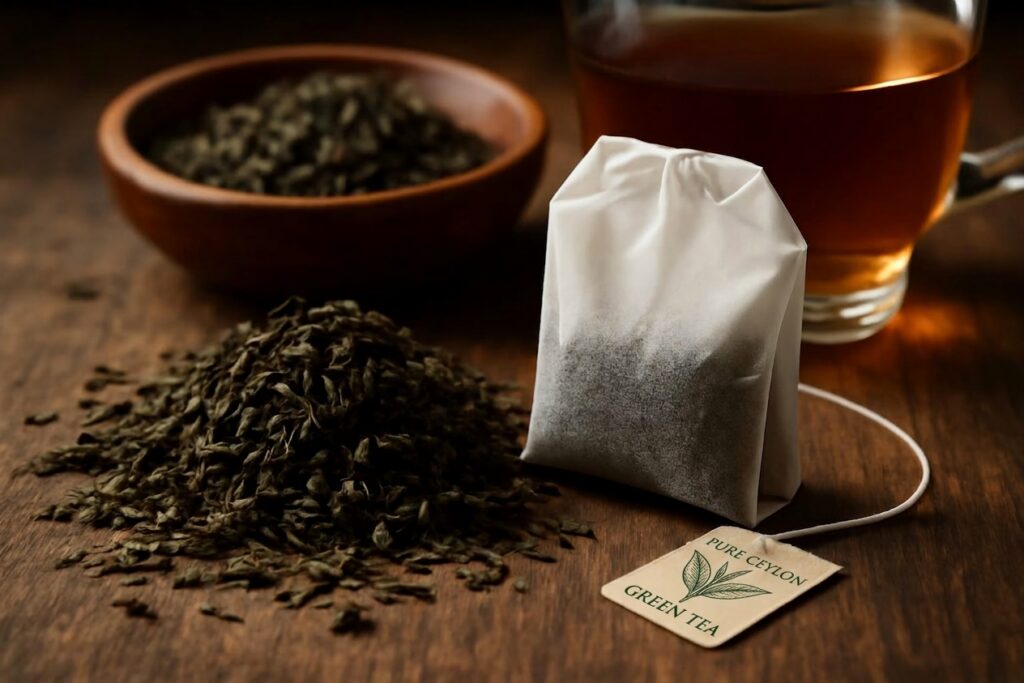
Sep
Taste, quality, microplastics and environment — we compare the two worlds tea bags and loose tea honestly and without marketing fairy tales. So you can enjoy your cup of tea with a clear conscience from now on. At first glance, the choice seems to be a matter of taste — but in fact it's about much more: depth of flavour, sustainability, microplastic risk, and not least the moment of enjoyment itself.
Loose tea
Whole leaves, unbroken flowers, visible pieces of fruit and herbs — unprocessed quality straight into your pot.
- Full flavour from whole leaves
- Higher quality grade (mostly premium leaf grades)
- Visible ingredients — transparency
- Multiple infusions possible (green tea, pu-erh, oolong)
- No microplastic risk
- More sustainable (less packaging)
- A little more effort in preparation
- A tea strainer or tea filter is needed
- Higher purchase price per pack
- Less practical on the go
tea bags
Small-leaf tea (fannings or dust) in pre-portioned bags — quick, practical, ready to use anytime.
- Simple, quick preparation
- No strainer required
- Practical on the go & at the office
- Pre-portioned — no need to measure
- Quick infusion (3–5 min)
- Low entry price per cup
- Usually lower quality (fannings/dust)
- Less depth of flavour
- Turns bitter quickly if steeped too long
- More packaging per cup
- Microplastic risk with plastic bags
- Only one infusion possible
What's it actually about?
Tea is the most-drunk beverage in the world after water — and between the first cup in the morning and the nightcap in the evening, tea lovers keep asking themselves the same question: Loose tea, or the convenient tea bag after all?
In this article, we compare both options honestly, without favouring either side, and help you find the right choice for your everyday life — from depth of flavour to microplastic risk.
Loose tea — tradition with character
Loose tea has been the original form in which tea is enjoyed for thousands of years. Whole leaves, unbroken flowers, visible pieces of fruit and herbs — everything the tea plant has to offer goes into your pot in unprocessed form.
Why loose tea is popular with tea connoisseurs
The decisive difference lies in the leaf size: with loose tea, the leaves remain largely whole or coarse-cut. When infused, they can unfurl fully and release their essential oils, aromas and constituents optimally into the water. The result is a cup with noticeably more depth, complexity and freshness.
Loose tea is especially suited to quiet tea moments at home, to tea ceremonies, and to anyone who consciously takes the time for a really good cup. Anyone who has never tried loose tea before is often surprised at just how different a classic black tea, green tea or herbal tea can taste.
Tea bags — everyday convenience
The tea bag was invented in the early 20th century in the USA — supposedly by accident, when tea merchant Thomas Sullivan shipped his samples in small silk pouches. Since then, the tea bag has conquered the world. In Germany, billions of tea bags end up in our cups every year.
What's inside a classic tea bag?
Classic tea bags mostly contain small-leaf tea, known as fannings or dust grade: the smallest leaf particles left over after processing. There's a reason for this — crushed tea releases its flavours quickly, resulting in a fast brewing time. But it also means: more bitterness and often a one-dimensional taste.
Loose tea vs. tea bags — at a glance
The compact overview of all the criteria — from taste to packaging waste:
| Criterion | Loose tea | tea bags |
|---|---|---|
| Aroma & taste | Full, complex, fresh | Compact, often one-dimensional |
| leaf size | Whole/coarse leaves | Fannings/dust (small) |
| Quality grade | Mostly premium | Standard/mid-range |
| Practicality | Strainer needed | Ready to use instantly |
| Multiple infusions | Often 2–4 possible | Usually only 1× |
| Microplastic risk | None | High with plastic bags |
| Packaging waste | Low | High (per cup) |
| Price per cup | Medium to high | Affordable |
| Transport/on the go | Limited | Very good |
🌿 Loose tea
- Aroma & taste
- Full, complex, fresh
- leaf size
- Whole/coarse leaves
- Quality grade
- Mostly premium
- Practicality
- Strainer needed
- Multiple infusions
- Often 2–4 possible
- Microplastic risk
- None
- Packaging waste
- Low
- Price per cup
- Medium to high
- On the go
- Limited
👜 Tea bags
- Aroma & taste
- Compact, often one-dimensional
- leaf size
- Fannings/dust (small)
- Quality grade
- Standard/mid-range
- Practicality
- Ready to use instantly
- Multiple infusions
- Usually only 1×
- Microplastic risk
- High with plastic bags
- Packaging waste
- High (per cup)
- Price per cup
- Affordable
- On the go
- Very good
The microplastic problem in tea bags
A study by McGill University in Canada (2019) caused quite a stir — and has since been seen as a turning point in the discussion around plastic tea bags:
From a single plastic pyramid bag, when brewed…
Source: McGill University, Canada (2019) · 95 °C water temperature
particles per cup — already visible under the microscope
even smaller particles per single cup of tea
What is microplastic in tea?
Many modern tea bags — especially the transparent pyramid designs — are no longer made of paper, but of polypropylene (PP), polyethylene terephthalate (PET) or nylon. On contact with boiling water, these materials release tiny plastic particles into the drink.
Even classic paper tea bags can be problematic: many are heat-sealed with polypropylene fibres or contain adhesives and binders, which can likewise release particles in hot water.
What the research says
The long-term health effects of microplastics in drinking water and food are currently being researched worldwide. While not all the consequences have been conclusively clarified, consumer protection organisations such as the Verbraucherzentrale and the German Federal Institute for Risk Assessment (BfR) advise caution and avoiding unnecessary microplastic intake.
A 2023 study by Stiftung Warentest additionally showed that many conventional tea bags contain pesticide residues that are found far less often in loose organic teas.
Pyramid bags — the compromise?
Pyramid bags are the tea industry's answer to the desire for more quality alongside convenience. Thanks to their three-dimensional shape, the tea leaves have more room to unfurl — which in theory allows for a better flavour.
However: most pyramid bags are made of plastic (nylon, PET or PLA). This undermines the supposed quality advantage — quite literally — once you factor in the microplastic risk.
Environment & sustainability
When it comes to sustainability, loose tea wins almost every time. The packaging share per cup is significantly lower, the material used is usually paper or aluminium-free film, and there are no individual bagsending up in the bin after every cup.
A rough calculation: an average tea drinker in Germany consumes about 500 cups of tea a year. For bagged tea, that means: 500 bags + 500 wrapper papers + 500 strings/tags + 500 staples. For loose tea: approx. 5–10 packaging units per year.
Anyone who drinks tea regularly can save hundreds of individual packaging parts a year by switching to loose tea — while noticeably improving tea quality at the same time.
Which choice for which moment?
Both forms of tea have their place. Here's an honest guide to when each choice makes sense:
Loose tea
- Conscious time for moments of enjoyment
- If you care about sustainability & avoiding microplastics
- You appreciate premium quality
- Multiple infusions possible
- At home or in the office with a teapot
tea bags
- On the go without a tea strainer & pot
- A quick cup on the run
- Tea as an occasional drink
- Tip: always choose plastic-free bags!
Combine both
- Loose premium tea at home for enjoyment
- Plastic-free bags at the office
- Refillable stainless steel tea infusers
- Organic cotton for on the go
Conclusion — the cup that suits you
If we're honest: loose tea wins in almost every categorythat really matters — taste, depth of flavour, quality, sustainability and, above all, avoiding microplastics. The only real advantage of the tea bag is convenience on the go.
Our recommendation: try loose tea if you haven't already. You'll be surprised how much more character, depth and freshness a cup can hold. Start with a variety you already know from your tea bag repertoire — for example a classic black tea, a mild rooibos or a refreshing herbal tea. You'll taste the difference.
Frequently asked questions
Is loose tea really better than tea bags?
Loose tea generally contains higher-quality tea leaves with more antioxidants and flavour compounds. Above all, it avoids the microplastic risk found in many modern plastic tea bags. With classic paper bags, the risk is lower, but adhesives and binders can also be problematic.
Which tea bags are plastic-free?
Plastic-free tea bags are made from 100% untreated filter paper (without polypropylene heat-sealing) or from PLA made from corn starch. When buying, look for wording like “plastic-free”, “compostable” or “made from corn starch”. Pyramid bags made from nylon or PET are not plastic-free.
What's the best way to prepare loose tea?
You'll need a tea strainer (stainless steel, glass or organic cotton), a teapot or a tea filter. Use 1–1.5 tsp of loose tea per cup and infuse with the right water temperature: black tea 95 °C, green tea 70–80 °C, herbal tea 95–100 °C, white tea 75–80 °C, mate 90 °C. Steep for 3–8 minutes depending on the variety. Exact values are given on every tea pack.
Can I infuse loose tea more than once?
Yes — especially with high-quality green teas, pu-erh, oolong and white teas, 2–4 infusions are possible, with each infusion revealing a slightly different flavour profile. Black tea usually tolerates 1–2 infusions, herbal and fruit teas generally only one.
Is the extra cost of loose tea worth it?
With premium varieties, yes: you usually pay only 20–40% more per cup, but get significantly higher quality, multiple infusions and a more sustainable product. Anyone who drinks tea regularly benefits both in taste and environmentally.
What's the difference between fannings and dust?
“Fannings” and “dust” are the two smallest leaf grades in the tea industry. Fannings are small leaf particles (1–2 mm), dust is powder-fine. Both are mainly used in tea bags because they release their flavour quickly. However, this also means: they turn bitter quickly and have less depth of flavour.
Are organic tea bags automatically better?
Organic teas are generally grown to a higher standard (no synthetic pesticides, no artificial fertilisers) — but the bag material can still be plastic. So watch out for both: organic certification of the tea AND plastic-free bag material.
How much microplastic does a pyramid bag release?
According to a study by McGill University (2019), a single plastic pyramid bag, when brewed with 95 °C hot water, can release over 11 billion microplastic particles and around 3 billion nanoplastic particles into a single cup of tea.
Note: The content of this article is for general information purposes only. Scientific studies and research findings are cited as of the date of publication; the discussion around microplastics and food is the subject of ongoing research. For specific health questions, please consult a medical professional.
You might also like
Discover in the shop: all tea varieties view →